
Chelmsford Sprint Races: 5f and 6f Betting Angles, Draw & Speed Profiles
 Available in US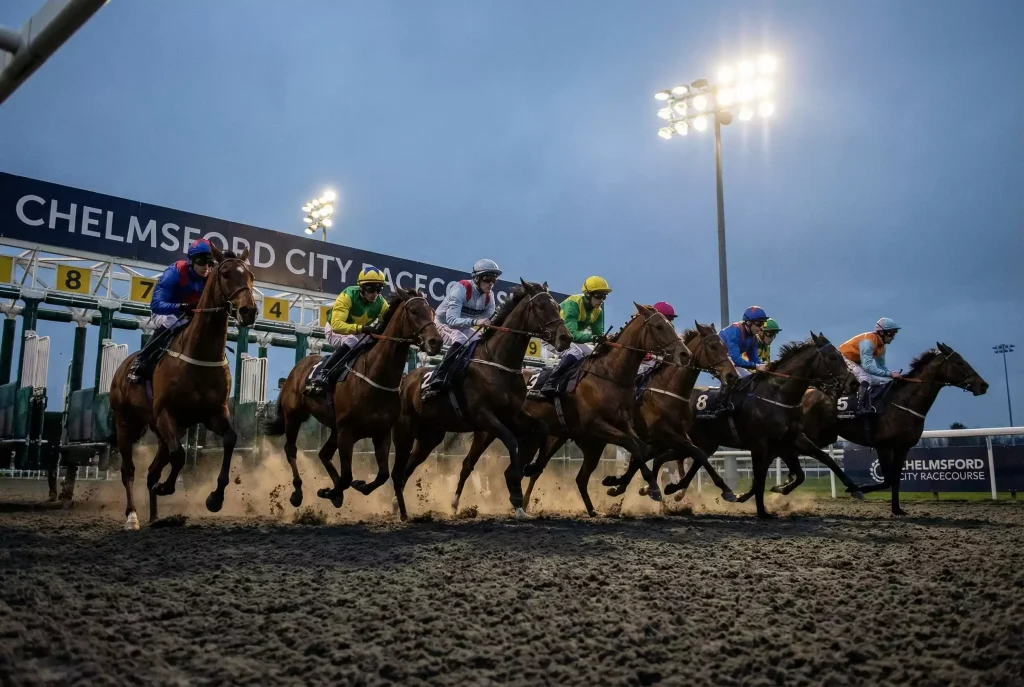
For expert betting guides visit chelmsford betting.
Five Furlongs: The Draw Is Everything
The five-furlong start at Chelmsford is from a chute on the far side of the course, positioned so that runners race in an approximately straight line for the first two furlongs before encountering the bend into the home straight. The stalls are set across the width of the track, with low numbers closest to the inside rail and high numbers on the outside.
This configuration creates one of the most pronounced draw biases in British all-weather racing. Horses drawn in stalls one through four have a demonstrable advantage over those drawn in stalls eight and above. The mechanism is simple geometry: a low-drawn horse that breaks well can angle across to the rail within the first furlong and hold a ground-saving position through the bend. A high-drawn horse must either use energy to cross to the rail early — losing momentum in the process — or race wide through the bend, covering extra ground. Over five furlongs, where the entire race is decided in approximately 60 seconds, that extra ground can be the difference between winning and finishing mid-division.
The statistical evidence is consistent across multiple seasons of data. Course analysis services report that low-drawn runners at Chelmsford over five furlongs outperform market expectations significantly, with stalls one to three returning positive level-stakes profit over large sample sizes. High-drawn runners, conversely, show persistent negative returns. The effect is amplified in smaller fields (six to eight runners) where the stall positions are more spread across the track, and slightly diluted in larger fields where all stalls are compressed toward the inside.
Pace is the second critical factor. Over five furlongs, there is no time to recover from a slow break or an unfavourable early position. A horse that dwells at the start and gives up two lengths in the first furlong is, effectively, beaten before the race begins. Front-runners dominate at this distance because the track geometry and the kickback effect combine to penalise horses racing in behind. A horse that leads from stall two, holding the rail through the bend, faces no kickback, saves ground, and controls the tempo. Horses trapped behind the leader receive synthetic material in their face for the entire race and have fewer than three furlongs to make up ground once they find clear running.
The practical application is to weight your analysis heavily toward draw and pace. A horse drawn in stall one with a confirmed front-running style is the automatic starting point in any five-furlong analysis, regardless of form. A horse with superior form but drawn in stall ten and a hold-up running style faces a structural disadvantage that may overwhelm its class edge. Speed, draw and break — the sprint formula at Chelmsford over five furlongs is a formula where position matters more than rating.
Six Furlongs: Same Chute, Different Race
The six-furlong start uses the same chute as the five, with stalls positioned further back to accommodate the extra furlong. The field breaks and runs toward the bend as before, but the additional distance changes the dynamics in meaningful ways.
First, the draw bias softens. There is more time — roughly ten to twelve additional seconds of racing — for the field to sort itself out before the decisive phase in the home straight. A horse drawn wide that breaks well can use the first furlong to work across to a more favourable position without the same energy cost that would be terminal over five furlongs. The bias still favours low numbers, but the magnitude of the advantage is smaller. Middle draws (stalls four to seven) become viable rather than disadvantaged, and high draws, while still less ideal, are not the death sentence they can be over five furlongs.
See also: Chelmsford mile races — betting strategy for 7f and 1m races.
Second, pace is important but not entirely dominant. Front-runners still perform well over six furlongs at Chelmsford — the kickback effect persists, and the surface favours prominent racers — but hold-up horses have a realistic chance of closing from off the pace because they have the extra furlong in the straight to make up ground. The bend into the home straight becomes a tactical pivot: horses that are positioned well entering the bend gain a decisive advantage over those who are still searching for running room. Jockeyship matters more over six furlongs than five. The ability to sit third or fourth through the early stages, save ground on the bend, and deliver a challenge in the final furlong is a skill that certain Chelmsford-regular jockeys execute consistently.
The BHA’s Racing Report confirmed that 73 per cent of all-weather Flat races in early 2026 attracted eight or more runners — and sprint races at Chelmsford frequently sit at the upper end of that range. A twelve-runner six-furlong handicap is a different betting proposition to a six-runner conditions sprint. Larger fields compress the stalls, reduce the draw differential, and produce more unpredictable outcomes. In big-field six-furlong handicaps, the draw is a factor but not the dominant one — pace, class, and trainer intent become coequal considerations.
The betting approach for six furlongs should be more balanced than for five. Still favour low-to-middle draws. Still look for pace horses. But give more weight to the quality of the horse’s recent form, its class relative to the field, and the jockey’s ability to navigate the tactical puzzle of a larger field. At five furlongs, the sprint formula is mechanical — draw plus pace equals advantage. At six furlongs, the formula is tactical — draw plus pace plus positioning plus class equals outcome. The extra furlong turns a physics problem into a chess problem, and the punter who reads the board before the pieces move has the edge.
