
Chelmsford Mile Races: 7f and 1m Betting Strategy, Draw Shifts & Trip Specialists
 Available in US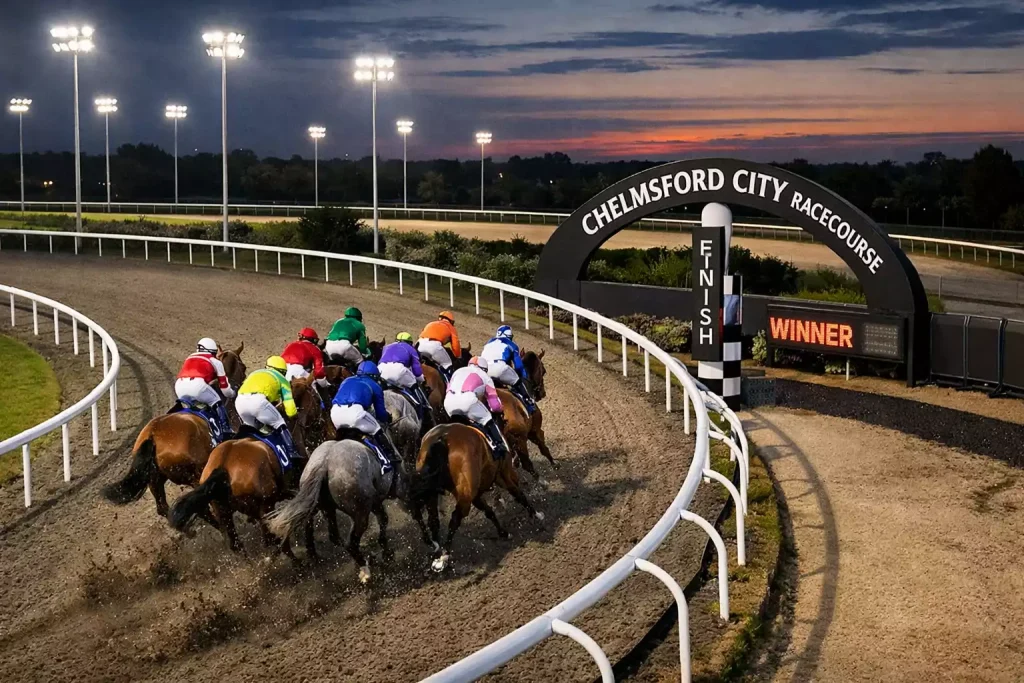
All racing analysis at chelmsford betting.
Seven Furlongs: The Transition Distance
Seven furlongs at Chelmsford is a transition distance — long enough that the sprint draw bias has softened, short enough that pace and position still matter. The start is on the far side of the oval, and runners negotiate the back straight and the long sweeping bend before entering the home straight. Unlike the five and six-furlong starts from the chute, the seven-furlong start gives the field time to sort into racing positions before any bend becomes relevant.
The draw at seven furlongs is less decisive than at sprint distances, but it is not neutral. Middle-to-low stalls retain a slight advantage because they have a shorter path to the rail if the jockey wants to tuck in early. High draws are not penalised as severely as at five furlongs, but a horse drawn in stall eleven or twelve in a full field will cover marginally more ground around the bend than one drawn in stall three. Over a race lasting roughly 85 seconds, that marginal distance rarely determines the result on its own — but it can be the deciding factor in a tight finish, and tight finishes are common in competitive Chelmsford handicaps.
What changes at seven furlongs is the value of tactical flexibility. At five furlongs, you want a leader. At seven, you want a horse that can race prominently or track the pace without committing to the lead from flag fall. The extra furlong-and-a-half compared to a sprint means the energy cost of leading throughout is higher, and a horse that sets too aggressive a tempo can tie up in the final furlong. The “tracker” profile — a horse that sits second or third, saves energy on the bend, and quickens in the straight — is often the ideal seven-furlong type at Chelmsford.
Form at precisely seven furlongs is worth weighting heavily. Some horses are genuine seven-furlong specialists — too slow for sprints, not quite staying a mile — and their records at the trip are concentrated and informative. A horse with three wins from five runs at exactly seven furlongs on Polytrack is telling you something specific about its optimal conditions. At Chelmsford, where the year-round fixture schedule generates a large sample of seven-furlong races, these specialists accumulate form quickly. Trust the distance form at this trip — it is a stronger predictor than class or rating in competitive handicaps.
One Mile: A Full Circuit, a Different Puzzle
One mile at Chelmsford covers a complete circuit of the oval — or close to it, depending on where the stalls are positioned. Runners negotiate two bends, which is a fundamental change from the single-bend dynamic at shorter distances. Two bends mean two opportunities for ground to be lost or saved, two moments where position on the track matters, and twice the potential for wide-running horses to cover extra distance.
See also: Chelmsford sprint races — betting angles for 5f and 6f sprints.
The draw at a mile is the most neutral of any distance at Chelmsford, but “neutral” does not mean “irrelevant.” Statistical analysis of results by stall position over one mile shows a much flatter distribution than at sprint distances — stall one and stall twelve produce broadly similar win rates over large samples. The reason is time: over a mile, the field has roughly 100 seconds of racing to settle into position, and the additional straight running before and between bends allows wide-drawn horses to find the rail without the desperation that a wide draw at five furlongs demands. That said, in very large fields (fourteen or more runners), a high draw can still be a mild negative because the sheer volume of horses makes it harder to navigate to a good position early.
Class and rating become more important at a mile because the extended distance rewards ability more than tactical fortune. Over five furlongs, a moderate horse with a good draw and early speed can beat a better horse drawn badly. Over a mile, the better horse usually prevails because there is enough race for ability to assert itself. For punters, this means the form book is a more reliable guide at one mile than at sprint distances — the horse with the best recent form, at the right class, carrying the right weight, is more likely to run to its rating than at shorter trips where positional factors can override quality.
Trip specialists exist at one mile just as they do at seven furlongs, but they are harder to identify because many trainers consider “a mile” a default distance rather than a speciality. The genuine mile specialist is the horse whose form at exactly eight furlongs is markedly better than at seven or nine. These horses have a natural cruising speed that suits the tempo of a mile race — quick enough to hold a prominent position, strong enough to sustain it through two bends and up the home straight. Identifying them from the form requires comparing performances at adjacent distances: if a horse finishes second at a mile but fourth at seven furlongs and third at a mile and a quarter, you are looking at a horse that peaks at exactly one mile.
The competitive nature of Chelmsford’s mile-distance fields rewards careful analysis. According to BHA data, 73 per cent of all-weather Flat races in early 2026 featured eight or more runners, and the mile handicaps at Chelmsford are typically among the best-attended races on any card. These fields are deep, competitive, and informative — every result adds a data point to the form web connecting the horses, trainers, and jockeys who contest this distance regularly. The punter who tracks mile form at Chelmsford across a full winter season builds a picture that no single racecard can provide. Where the draw picture changes, the form picture sharpens — and at one mile, form is the primary currency.
