
The Complete Chelmsford Betting Guide: Data, Strategies & Expert Picks
 Available in US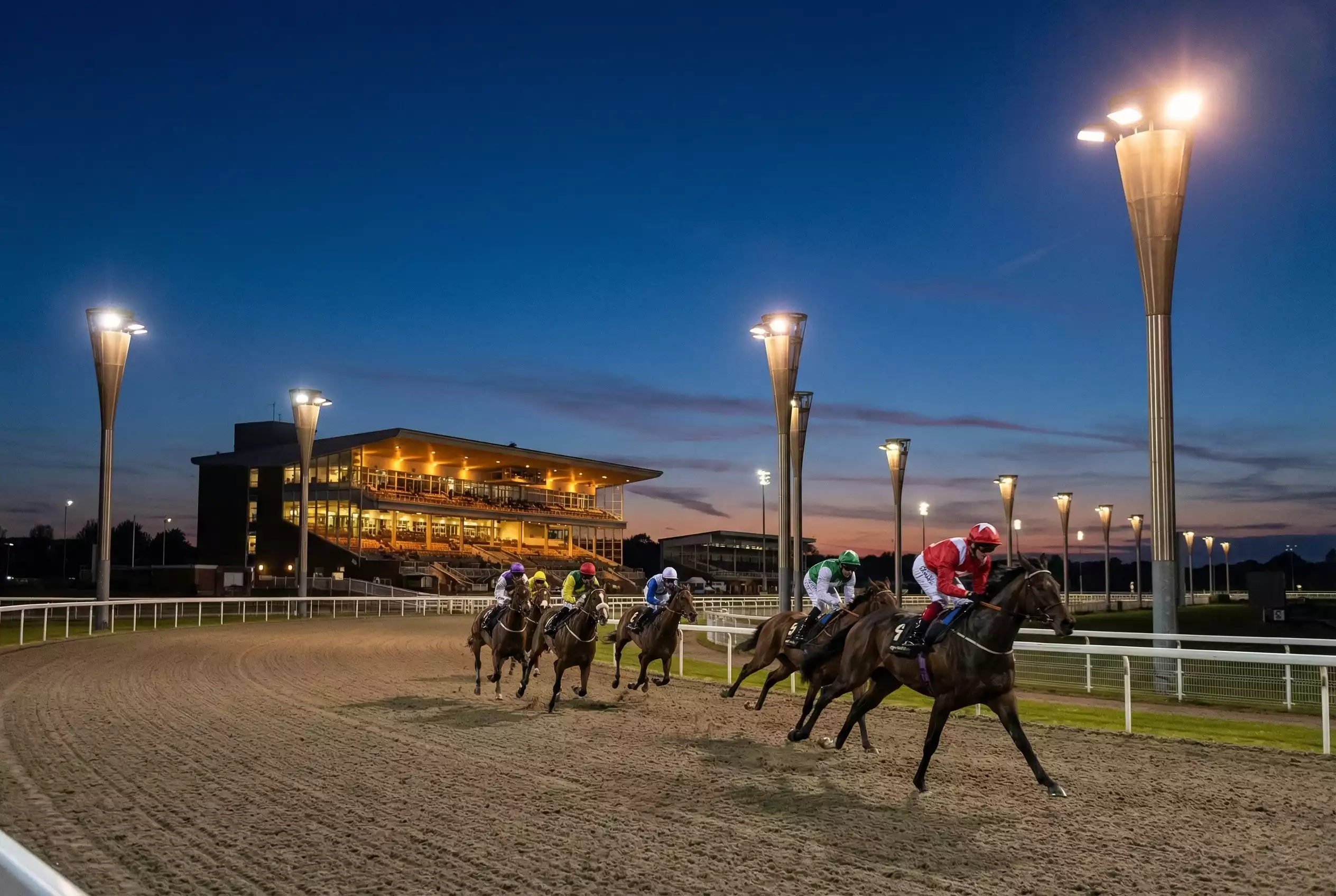
Chelmsford betting is one of the most data-rich corners of UK horse racing, and most punters never scratch the surface. Chelmsford City Racecourse, the sole track in Essex, runs exclusively on Polytrack — a synthetic all-weather surface that strips out the randomness of rain-soaked turf and replaces it with something measurable: consistent going, repeatable draw biases, and trainer-jockey patterns that hold up over hundreds of races. The course stages more than 60 fixtures per year, nearly all under floodlights, making it a year-round betting market that doesn't shut down when the clocks go back.
What makes Chelmsford particularly interesting for anyone serious about data-driven betting at Chelmsford City is the gap between what the track offers and what most bettors actually use. The draw bias data alone — stall-by-stall, distance-by-distance — gives you an edge that the majority of casual punters ignore entirely. Layer on front-runner win rates, the dominance of specific trainer-jockey combinations, and the fact that Chelmsford consistently fields competitive races with large runner counts, and you start to see why this track rewards preparation over instinct.
The venue itself has undergone a remarkable transformation. Born from the ashes of the ill-fated Great Leighs — Britain's first new racecourse in over 80 years, which opened in April 2008 and went into administration barely nine months later — Chelmsford City relaunched in 2015 and has been climbing ever since. The Good Friday Festival in 2025 saw attendance jump 42% year on year, a sign that the track's investment in prize money, media coverage, and flagship races is paying off. The Cardinal Stakes alone drew half a million ITV viewers in 2024, and this year the course hosts its first-ever ITV Racing broadcast — the Sky Bet Sunday Series on 1 June 2025.
This guide breaks down everything that matters for betting on Chelmsford races: track characteristics, draw bias numbers, pace analysis, the trainers and jockeys who dominate the course, key races worth targeting, and the broader UK betting market context that shapes odds and liquidity. Every claim is backed by data from official sources — BHA reports, Gambling Commission statistics, the Horserace Betting Levy Board, and Chelmsford City Racecourse itself. No filler, no vague tipster promises. Just the numbers and the analysis you need to bet smarter.
What This Guide Covers — And Why the Numbers Matter
- Chelmsford's Polytrack surface produces measurable draw biases — low stalls dominate at 5f and 6f, while Stall 9 at 1m2f returns a remarkable +74.58 LSP.
- Front-runners outperform hold-up horses across most distances, amplified by the kickback effect on synthetic surfaces.
- A handful of trainer-jockey combinations deliver consistent results, led by course specialists who target Chelmsford's industry-leading Class 5 and Class 6 prize money.
- The UK horse racing betting market has contracted 16.3% over two years to £8.73 billion, driven by affordability checks — context that directly affects odds and liquidity.
- The Cardinal Stakes, with its £100,000 purse and Kentucky Derby pathway, headlines a fixture list that now includes ITV Racing coverage for the first time in 2025.
Chelmsford City Track Guide: Polytrack, Layout and What It Means for Your Bets
Chelmsford City is a left-handed, roughly one-mile oval with a Polytrack all-weather surface — one of six floodlit AW tracks in the UK capable of racing year-round. The track configuration matters more than most bettors realise. The left-handed direction, the gentle camber through the bends, and the dedicated chute for 5f and 6f starts all create specific advantages for certain stall positions and running styles. Unlike turf courses where ground conditions vary meeting to meeting, Polytrack delivers a surface that rarely shifts beyond "Standard" on the going stick, meaning historical data retains predictive value far longer than it would at, say, Ascot in October.
The surface itself is a composite of silica sand, polypropylene fibres, recycled rubber granules, and a wax coating that aids drainage. In practical terms, this means the track does not churn up, does not develop false patches, and does not favour one running style simply because the ground has changed since the last race. That consistency is the single most important factor for data-driven betting at Chelmsford City — it turns the track into something closer to a controlled environment than the open-air lottery of turf racing.

Neil Graham, Director of Racing at Chelmsford City Racecourse, has been explicit about the venue's identity: "Our core product is floodlit racing between September and March and our key races are those at Classes 4, 5 and 6 level." That statement, from Chelmsford's own prize money report, tells you exactly where to focus your analysis — the evening cards that run through the winter months, featuring the mid-to-lower-class handicaps and conditions races that form the backbone of the programme.
The track's growth trajectory reinforces why it deserves serious attention. Back in 2018, Chelmsford staged 63 fixtures with total prize money of £5.2 million, including what was then the most valuable floodlit evening meeting in UK racing history. Since then, prize money has climbed further, the fixture list has expanded, and the course has secured its first ITV Racing broadcast for 2025. For bettors, more fixtures means more data. More prize money means stronger fields. And stronger fields mean more reliable form lines to work with.
Understanding the physical track is step one. Step two is knowing exactly how that layout translates into stall advantages — and that means digging into the draw bias data.
Draw Bias at Chelmsford: What the Stall Data Actually Shows
Draw bias at Chelmsford is real, measurable, and — at certain distances — significant enough to shift the odds in your favour before the stalls even open. The consistency of the Polytrack surface means that unlike turf courses, where bias can flip depending on the weather, Chelmsford's stall advantages persist across seasons. The numbers below are drawn from large sample sizes and should be treated as a structural feature of the track, not a short-term anomaly.
Sprint Distances: 5f and 6f
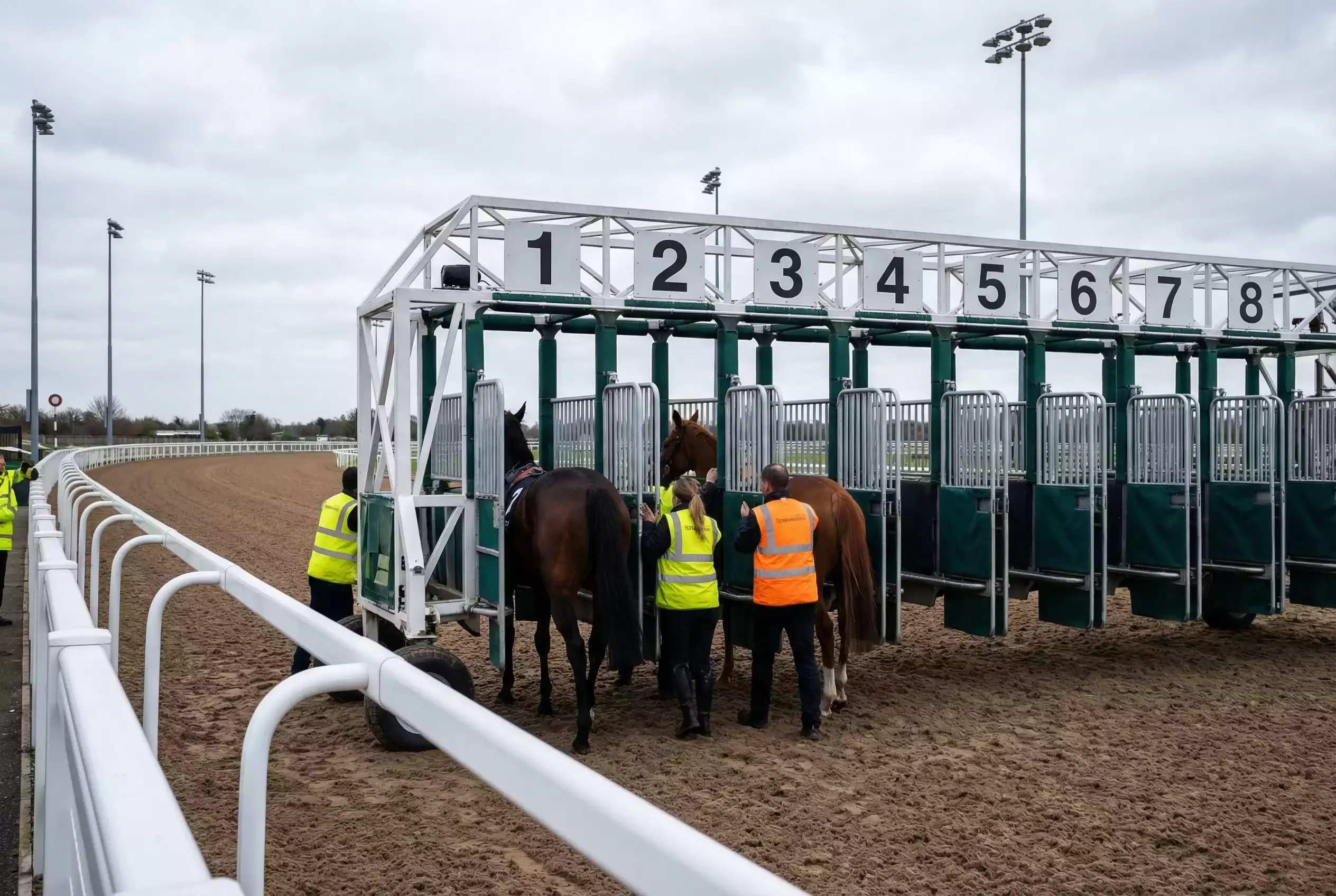
At five furlongs, the draw is everything. Races start from a chute that feeds into the home bend, and horses drawn low — stalls 1 through 4 — have a direct rail path into the turn. High draws must cover extra ground to find position, and in a flat-out sprint where margins are measured in fractions of a second, that is often the difference between winning and placing at best. The data from sites like OLBG and Geegeez consistently shows low stalls outperforming in win percentage and ROI at this trip. If you are betting the 5f at Chelmsford and the horse you fancy is drawn in stall 10 of 12, the numbers suggest you should think twice — or at least adjust your expected value downward.
At six furlongs, the bias remains but softens slightly. The start position is further up the track, giving runners a longer run before the first bend. Low draws still hold an advantage, particularly in larger fields where traffic problems become more pronounced for those racing wide. In fields of ten or more, stalls 1 to 5 have historically produced a higher strike rate than their odds imply, making them a consistent source of value for punters who track starting positions.
Middle Distances: 7f and 1 Mile
The picture shifts at seven furlongs and a mile. At these distances, horses have more time to settle and find position, which means the raw stall number matters less than the jockey's tactical ability. The bias has not disappeared — middle draws tend to perform slightly better overall — but the edge is thinner and harder to exploit in isolation. What becomes more important at these trips is the combination of draw and running style: a horse drawn mid-pack with front-running form can use the rail effectively, while a closer from a wide draw faces the dual challenge of burning energy to get position and then finding a gap in the straight.
One pattern worth noting at a mile: horses drawn in stalls 5 to 8 have shown stronger LSP returns than either extreme, likely because they avoid the bunching on the rail that happens from low draws and the ground loss from high ones. This is where the data rewards nuanced analysis rather than simple "low is good, high is bad" rules.
Staying Trips: 1m2f and Beyond
At 1m2f and longer, the draw's influence fades substantially — with one notable exception. Stall 9 at 1m2f has returned a remarkable +74.58 LSP over a significant sample, an outlier that OLBG's course guide highlights specifically. Whether this is a genuine structural advantage or a statistical quirk amplified by a few big-priced winners is debatable, but the number is too large to ignore entirely. At longer distances, stamina, class, and trainer intent dominate. The draw becomes a tiebreaker rather than a primary factor.
For bettors, the practical takeaway is distance-dependent: at sprints, the draw is a near-mandatory filter in your selection process; at a mile, it is one of several factors; at 1m2f and beyond, it is background noise unless a specific stall produces an outlier like that Stall 9 figure. The smartest approach is to check the draw data before every Chelmsford bet, adjust your confidence accordingly, and never let a strong draw position alone convince you to back a horse whose form does not stack up.
Draw tells you where the advantage starts. Pace bias tells you how it unfolds once the race is underway.
Pace Bias on Polytrack: Why Front-Runners Thrive at Chelmsford
If there is a single tactical angle that separates profitable Chelmsford bettors from the rest, it is understanding pace bias. Front-runners — horses that lead from the start or sit prominently in the first two positions — win at a higher rate at Chelmsford than the average across all UK tracks. This is not speculation; it is a structural feature of Polytrack racing that shows up in years of results data.
The reason is partly physical. Polytrack surfaces produce "kickback" — loose material thrown up by the horse in front into the face and chest of those behind. On turf, kicked-up divots are occasional and localised. On Polytrack, the spray is constant and covers a wider area. Horses racing in behind get peppered throughout the race, which can break concentration, cause them to lose momentum, and in some cases lead them to resent the surface altogether. A horse that sits handy or leads outright avoids this entirely. Over a large enough sample, that advantage converts into a measurable win-rate differential.
The connection between draw and pace makes this even more actionable. At sprint distances, a low-drawn horse with front-running form effectively doubles its advantage: it gets the rail position from the stall and avoids kickback by racing clear. At Chelmsford specifically, data from Geegeez and OLBG confirms that front-runners from low draws at 5f and 6f produce some of the strongest flat-bet returns on any UK all-weather track. When a horse drawn 1 to 3 has shown speed in recent runs and the pace map suggests it could dictate terms, that is a scenario worth betting into with confidence.
The bias is not absolute. In small fields of five or fewer runners, there is less kickback and less traffic, which narrows the advantage. At longer distances, pace becomes less decisive because the horse has to sustain its position over more ground, and closers have more time to pick their way through. But for the standard sprint handicaps that fill a significant chunk of Chelmsford's evening cards, pace analysis should be a non-negotiable part of your pre-bet process. Ignoring it is leaving value on the table.
Pace gives you an angle on individual races. Building a repeatable strategy means combining it with the other factors that move the odds at Chelmsford.
Four Chelmsford Betting Strategies That Actually Hold Up
Strategy in all-weather betting is not about finding a magic formula. It is about stacking small, evidence-based edges until the cumulative effect tilts the maths in your direction. At Chelmsford, four angles have consistently produced value over large samples — not because the bookmakers are asleep, but because most casual punters simply do not bother to look at them.
The Front-Runner Filter
This is the most straightforward strategy and the one with the deepest data behind it. Before placing a Chelmsford bet, identify the likely pace scenario. If only one horse in the field has front-running form, that horse has a structural advantage — clean air, no surface spray, and the psychological benefit of dictating the tempo. The edge is strongest in fields of eight or more, which is exactly the scenario that dominates Chelmsford cards. According to BHA's March 2024 Racing Report, 73% of flat races at core all-weather meetings fielded eight or more runners, the highest proportion since 2007. Larger fields mean more traffic behind the leaders and more opportunity for a prominent racer to steal an uncontested lead.
Trainer-Jockey Combinations
All-weather tracks produce habitual winners. The consistent surface means that trainers who understand Polytrack — how to prepare horses for it, when to run them, which distances suit their string — build an informational edge that compounds race after race. When those trainers pair with their preferred jockeys, the effect compounds further. At Chelmsford, a handful of trainer-jockey partnerships produce win rates well above their expected strike based on starting prices. The key is tracking these combinations over a minimum of 50 runs to separate genuine skill from short-term variance. Resources like GetYourTipsOut and Timeform publish combination stats, but building your own dataset from racecard archives gives you a feel for when a partnership is peaking versus going through a quiet patch.
Distance Specialisation
Not all Chelmsford races are created equal. Sprint handicaps play out differently from mile races, which play out differently from 1m2f+ events. The data supports treating each distance band as a distinct betting market with its own rules: draw-heavy at 5f, pace-heavy at 6f, tactically open at a mile, and stamina-dependent at longer trips. Bettors who specialise in one distance band — learning the draw patterns, the trainers who target that trip, the jockeys who ride it best — tend to build a sharper edge than generalists who bet across the full card. If you can only follow one trip, sprints offer the most exploitable biases; if you prefer deeper analysis with fewer runners, the middle-distance route races reward form students.

Evening Racing Angles
Chelmsford's floodlit evening meetings are the bread and butter of the fixture list. The fields tend to be lower-class — Classes 4, 5, and 6 — which means smaller prize money relative to weekend features but also less attention from the professional betting syndicates that dominate the bigger meetings. For informed punters, this creates opportunity. Market prices on evening cards can be less efficient than at high-profile Saturday afternoon fixtures, particularly for horses that have shown form at the course before. The liquidity is lower, which means betting exchanges may not always offer competitive prices, but the fixed-odds market through bookmakers can throw up value for those who have done the homework on draw, pace, and connections.
The common thread across all four strategies is preparation. None of them work if you are scanning the racecard five minutes before the off. They reward bettors who check the draw, map the pace, research the connections, and compare odds before the market tightens.
Top Trainers and Jockeys at Chelmsford: Who Dominates the Data
Chelmsford's consistent Polytrack surface creates a feedback loop that benefits a relatively small pool of connections. Trainers who invest time in understanding the surface — how to prepare horses for it, which types suit it, when to return a runner after a break — build an informational edge that compounds race after race. And because Chelmsford offers the highest average prize money in the UK for Class 5 racing (£18,667 for two-year-olds) and Class 6 (£9,184 for older horses), the financial incentive to target the track is substantial. Neil Graham put it plainly: "As an independent racecourse, we are proud, as ever, to be pushing the boundaries by offering prize money well in excess of many of our competitors" — Chelmsford City Racecourse News.
Trainers to Follow
The names at the top of Chelmsford's trainer table will not surprise regular all-weather followers. Michael Appleby is a perennial presence, running high volumes across the AW circuit with a particular focus on sprint and middle-distance handicaps. His strike rate at Chelmsford may not be the flashiest in the top five, but the sheer volume of runners means he is always worth checking, especially when paired with his preferred jockeys. Stuart Williams, based relatively nearby, treats Chelmsford almost as a home track, and his win rate in lower-class races has been consistently above the market's estimation. Charlie Appleby — no relation to Michael — occasionally sends targeted runners from his Newmarket base, and when he does, the market generally respects the move with shorter prices.
The value, therefore, often lies elsewhere: trainers like Marco Botti and David O'Meara, who do not run at Chelmsford as frequently but show strong course-and-distance form when they do. These are the runners that slip under the radar in the morning markets and can still be backed at generous prices closer to post time. Tracking individual trainer records at the course — filtering by class, distance, and time of year — is one of the most productive uses of pre-race preparation time.
Jockeys Who Know the Track
Luke Morris is the jockey most synonymous with Chelmsford City. His ride count at the course dwarfs most competitors, and his familiarity with every nuance of the track — where to save ground, how to manage kickback, when to commit on the home turn — gives him a tangible advantage that the numbers confirm. Morris is not always on the best horse in the race, but he consistently outperforms market expectations, making him a positive ROI jockey at the course over a large sample. Other names to track include Callum Shepherd, who has shown a strong recent record, and Adam Kirby, whose appearances tend to be selective but effective.
Profitable Combinations
The real edge often lies in specific trainer-jockey pairings rather than backing either in isolation. A trainer who books a particular jockey for Chelmsford is sending a signal about intent, and the combination of that trainer's preparation with that jockey's course knowledge can produce results that exceed what either party would achieve separately. Tracking these pairings over a minimum of 30 to 50 runs is essential to distinguish signal from noise. The most profitable pairings tend to cluster around mid-class handicaps — the races where Chelmsford's prize money advantage attracts the strongest quality of runner for the grade, giving well-prepared combinations the best opportunity to outperform the field.
The trainers and jockeys tell you who is winning. The key races tell you when the stakes — and the data — matter most.
Key Races at Chelmsford City: Cardinal Stakes, Good Friday and the 2025 ITV Debut
Chelmsford's fixture list has evolved from a steady diet of evening all-weather cards into something with genuine flagship events. Three races and race days stand out — each offering a distinct betting opportunity and each reflecting the track's upward trajectory in UK racing's hierarchy.
The Cardinal Stakes
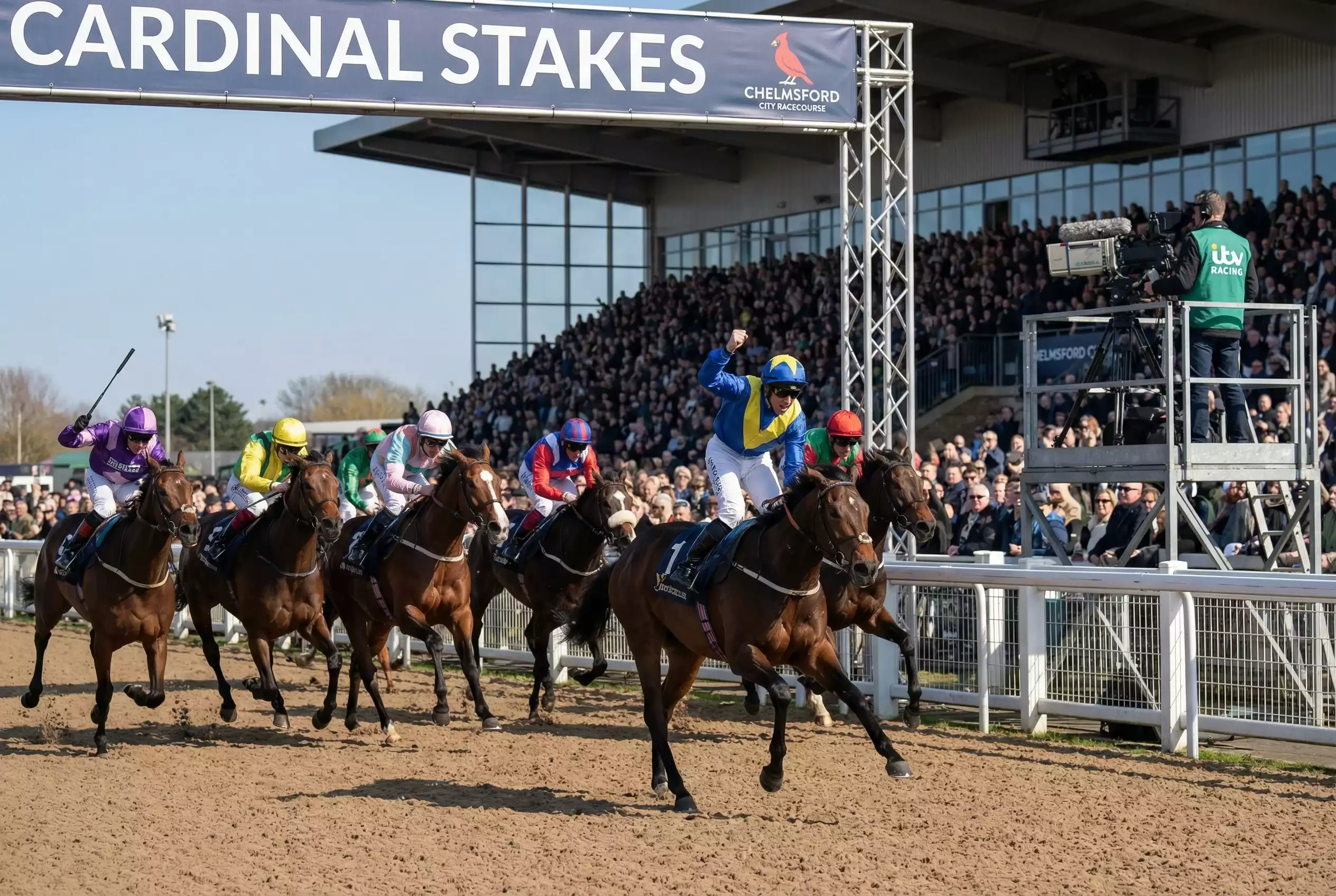
The Cardinal Stakes is the crown jewel of the Chelmsford calendar. Carrying a prize fund of £100,000, it ranks as the second most valuable Conditions race in Europe and has become a genuine international talking point. The race's ITV1 debut in 2024 attracted an audience of approximately 500,000 viewers, giving Chelmsford mainstream exposure that would have been unimaginable a decade earlier.
What elevates the Cardinal Stakes beyond its prize money is the Kentucky Derby pathway introduced in 2025. The winner now receives a free entry into the Grade I American Turf Stakes — a million-dollar race run on Kentucky Derby day at Churchill Downs. Neil Graham described the significance: "Chelmsford City Racecourse is delighted to be able to offer the winner of the Cardinal Stakes free entry into the ,000,000 Grade 1 American Turf" — Thoroughbred Daily News. That pathway changes the complexion of the race for connections: it attracts better-quality entries from trainers with international ambitions, which in turn produces stronger form for bettors to analyse.
Good Friday Finals Day
The All-Weather Championships Finals Day, held on Good Friday at Newcastle, is the centrepiece of the UK's AW season. It represents the climax of more than 200 fixtures across six racecourses from October through to April, with over £1 million in prize money on the line — making it the richest all-weather racecard in Europe. Chelmsford plays a central role in the qualifying season, hosting competitive cards throughout the winter that feed contenders into the finals. The Good Friday fixture at Chelmsford itself has become a standalone draw: the 2024 running set a record for ticket sales, and attendance in 2025 surged by 42% year on year. For bettors, the AW season offers the rare combination of form depth — horses qualified through months of competitive racing on a consistent surface — and heightened public interest, which can occasionally push favourites to shorter prices than the data supports, creating value on the each-way outsiders.
The 2025 ITV Racing Debut
In a move that signals Chelmsford's growing status, the 2025 fixture list includes the first-ever ITV Racing broadcast from the course — the Sky Bet Sunday Series on 1 June. A Premier raceday follows on 6 July, headlined by the Listed Queen Charlotte Stakes carrying prize money of £247,500. ITV coverage brings several implications for bettors: larger pools on Tote bets, more aggressive bookmaker pricing to attract viewers, and enhanced each-way terms on selected races. These are the meetings where market inefficiencies can emerge, particularly in the supporting races that receive less public attention than the feature event.
The races are where the action happens. But the odds you get — and the value you can extract — are shaped by forces much bigger than any single meeting. The UK betting market itself is changing, and understanding that context matters.
The UK Betting Market in 2026: Turnover Decline, Affordability Checks and What It Means for Chelmsford Punters
You cannot bet intelligently on horse racing without understanding the market you are betting into. And the UK horse racing betting market in 2026 looks very different from the one that existed five years ago. The numbers tell a clear story: contraction, regulatory pressure, and a fundamental shift in who is placing the bets and how much they are staking.
The headline figure is stark. Total betting turnover on British horse racing fell to £8.73 billion in the 2023/24 financial year, down from £10 billion just two years earlier — a decline of 16.3%. The BHA's own Racing Report for 2024 recorded a further 6.8% drop year on year, and first-quarter figures for 2025 showed another 9% contraction. Average turnover per race has fallen roughly 8% year on year, and is now 19% below its 2021/22 level, according to the Horserace Betting Levy Board's Annual Report for 2024-25.
Despite the turnover decline, the Levy yield — the levy that bookmakers pay to fund racing — hit almost £109 million in 2024/25, a record since the system was reformed in 2017. That apparent contradiction exists because the Levy is calculated on bookmaker profits (gross gambling yield), not raw turnover. Remote horse racing GGY stood at £766.7 million for the same period, according to the Gambling Commission's industry statistics. In other words, bettors are losing a higher proportion of what they stake. That should give any punter pause — it means the bookmaker margins you are betting against are widening, not narrowing.
The primary driver of the turnover decline is affordability checks — financial risk assessments that licensed operators are required to conduct on customers whose losses exceed certain thresholds. Richard Wayman, the BHA's Director of Racing and Betting, has been blunt about the impact: "I've no doubt that these [declines] are headed by the impact of affordability checks and the extent to which they have resulted in people either stopping betting or placing their bets with unlicensed operators" — BHA Racing Report 2024. The scale of the problem is concentrated: according to parliamentary data cited in Hansard, approximately 85% of online bookmaker revenue from racing comes from just 5% of accounts. When those high-staking customers face enhanced checks, the ripple effect on turnover, liquidity, and ultimately prize money is disproportionate. Modelling by Regulus Partners has projected worst-case annual losses of up to £50 million for the racing industry, with £10 to £11 million in direct Levy impact.
For Chelmsford bettors specifically, this market context matters in practical ways. Thinner turnover per race means less liquid betting markets, particularly on the evening cards that form the bulk of the fixture list. Less liquidity can mean wider spreads between best and worst prices across bookmakers, making odds comparison even more critical than it already was. It also means that exchange markets for Chelmsford evening races may be shallower than those for Saturday afternoon meetings at bigger tracks, pushing more bettors toward fixed-odds bookmaker prices. None of this changes the fundamentals of good handicapping — draw, pace, connections — but it does change the economics of how and where you place your bets.

Market context shapes the landscape. Getting the best odds within that landscape is the simplest edge any bettor can claim — and it starts with comparison.
Comparing Chelmsford Odds: How to Find the Best Price Every Time
Odds comparison is the lowest-effort, highest-impact habit in horse racing betting. It requires no form analysis, no pace mapping, no draw data — just the discipline to check multiple bookmakers before you place a bet. The principle is simple: different bookmakers price the same horse differently, and over hundreds of bets, consistently taking the best available price adds measurable percentage points to your long-term return. On a race-by-race basis, the difference might be between 7/2 and 4/1 on the same runner. Over a year of Chelmsford betting, that difference compounds into real money.
For Chelmsford specifically, odds comparison is especially valuable on the evening cards where bookmaker pricing can be less synchronised. The lower-profile nature of midweek all-weather meetings means that some operators rely more heavily on automated algorithms to set their prices, while others may apply manual overrides based on market intelligence. The result is wider variation in prices than you would typically find on, say, a Group 1 at Ascot. Using an odds comparison aggregator — or simply checking three or four bookmakers before clicking "place bet" — takes sixty seconds and can shift the value equation materially in your favour.
Best Odds Guaranteed (BOG) policies are another consideration. Most major UK bookmakers offer BOG on UK horse racing, which means if you take an early price and the Starting Price (SP) ends up higher, you receive the bigger payout. This effectively gives you a free option: you lock in a price you are happy with, and if the market moves in your favour, you benefit automatically. Not all bookmakers extend BOG to every Chelmsford meeting, so check the terms — some exclude certain evening fixtures or lower-class events.
Timing also matters. For Chelmsford evening races, morning prices are typically set by 10:00 AM and can offer value before the market contracts through the afternoon. Late money — significant bets placed in the final 10 to 15 minutes before the off — can move prices sharply, particularly in smaller fields. If you have a strong opinion on a race, taking an early price with BOG is usually the optimal approach. If you prefer to react to market moves, watching the exchanges in the final minutes can reveal where the informed money is going.
Common Questions About Betting at Chelmsford City
Is there a significant draw bias at Chelmsford City?
Yes, particularly at sprint distances. At 5 furlongs, low-drawn horses — stalls 1 through 4 — have a clear statistical advantage because the chute start feeds directly into the home bend, and inside positions save ground through the turn. At 6 furlongs, the bias softens but low draws still outperform in larger fields. At 7 furlongs and a mile, middle stalls tend to fare best, avoiding both rail crowding and wide-draw ground loss. At 1m2f and beyond, draw matters less, though Stall 9 at 1m2f has produced an unusually high Level Stake Profit of +74.58 over a substantial sample. The key takeaway is that draw bias at Chelmsford is not a blanket rule — it is distance-specific, and the smart approach is to weight it heavily at sprints, moderately at middle distances, and lightly at staying trips. Always cross-reference draw position with field size, as larger fields amplify the bias.
What type of horse tends to perform best at Chelmsford?
Front-runners and prominently raced horses hold a structural advantage at Chelmsford due to the Polytrack surface's kickback effect. The synthetic material throws up a persistent spray of loose particles that can unsettle horses racing in behind, particularly at sprint and mile distances. Horses that show early speed, break cleanly, and can dictate or sit close to the pace tend to outperform closers in aggregate data. Beyond running style, course-and-distance form is an especially reliable predictor on all-weather surfaces because the consistent going means that a horse's previous performance at the track is more likely to be replicated than on turf, where ground conditions vary. Horses with proven Polytrack form from any of the three UK Polytrack venues — Chelmsford, Kempton, or Lingfield — deserve extra attention when running at Chelmsford, as surface preferences transfer well between these tracks.
How does Chelmsford compare to other UK all-weather tracks for betting?
The UK has six all-weather racecourses: Chelmsford City, Kempton Park, and Lingfield Park on Polytrack; Wolverhampton, Newcastle, and Southwell on Tapeta. Chelmsford distinguishes itself in several ways. It leads the country in average prize money for Class 5 and Class 6 races, which attracts stronger fields than you might expect at these lower grades — more competitive racing means more form to work with. The left-handed oval configuration produces different draw dynamics from right-handed Kempton or the tight Wolverhampton circuit. Chelmsford's floodlit schedule also provides the most consistent winter racing programme of any AW track, with the All-Weather Championships running across all six venues from October to Good Friday. For bettors, each track demands its own form analysis: Polytrack form transfers reasonably well between Chelmsford, Kempton, and Lingfield, but translating it to Tapeta requires caution, as surface preferences do not always carry over.
Responsible Gambling: Tools, Limits and Where to Get Help
Gambling involves risk. Only bet what you can afford to lose.
Horse racing betting should be entertainment, not a financial strategy. If betting stops being enjoyable, or if you find yourself chasing losses, the tools and resources below exist to help. Use them — they are free, confidential, and designed for exactly this situation.
Every licensed UK bookmaker is required to offer deposit limits, loss limits, session time reminders, cooling-off periods, and self-exclusion options. These are not buried in the terms and conditions — they are available in your account settings and can be activated in minutes. GAMSTOP provides a single point of self-exclusion across all licensed UK gambling operators: registering at gamstop.co.uk blocks you from all participating sites for a period of your choosing. The Gambling Commission's latest survey data shows that 7% of UK adults bet on horse racing in any given four-week period — this is a mainstream activity, and the support infrastructure reflects that.
If you or someone you know is struggling with gambling, the National Gambling Helpline is available on 0808 8020 133 (free, 24/7). GambleAware at gambleaware.org offers advice, self-assessment tools, and referrals to treatment services. Gordon Moody provides residential treatment for severe gambling addiction. These resources exist because the industry recognises that a small percentage of bettors will experience harm — the responsible approach is to know they are there before you need them.
