
Betting Exchanges vs Bookmakers for Chelmsford City Racing
 Available in US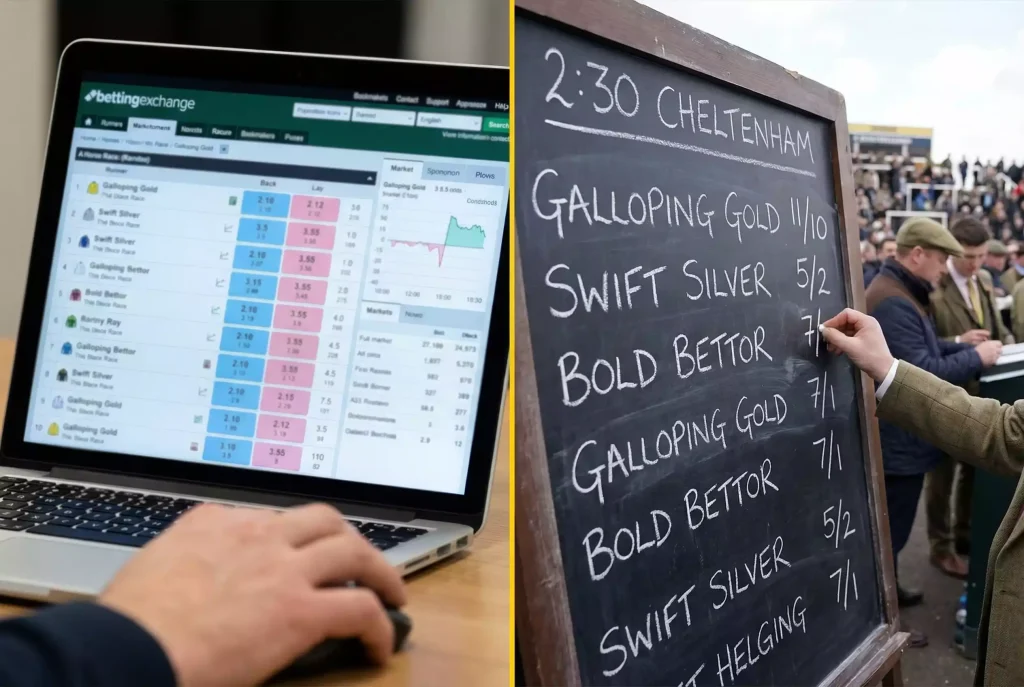
A betting exchange and a traditional bookmaker offer fundamentally different ways to bet on the same Chelmsford race. The bookmaker sets the odds, takes your bet, and pays out from its own book. The exchange is a marketplace where punters bet against each other: you can back a horse to win (just like with a bookmaker) or lay a horse — bet that it will lose — which is something no traditional bookmaker lets you do. Understanding the mechanics of both markets, and knowing when each one offers the better deal for Chelmsford City racing, is a practical edge that most casual punters never develop.
This guide explains how exchanges work, how they compare to bookmakers on price, liquidity, and functionality, and when to use which for all-weather betting.
How Betting Exchanges Work
On an exchange, every bet has two sides. When you back a horse at 5.0 (4/1), another user on the exchange is laying that horse at 5.0 — they are betting it will not win. The exchange matches the two sides and takes a commission on the winning bettor’s profit, typically between two and five per cent depending on the platform. No bookmaker is involved. The price is set by supply and demand, not by a trader in a pricing room.
This peer-to-peer structure has several consequences. First, exchange odds are often — though not always — better than bookmaker odds, because there is no built-in overround. A bookmaker prices every horse in a race such that the combined implied probabilities exceed 100 per cent; that excess is the margin. An exchange, because it simply matches backers and layers, does not build a margin into the odds. The commission replaces it, but commission is charged only on winning bets, which makes the effective cost lower for most punters. The Gambling Commission reported that gross gambling yield from remote horse racing betting was £766.7 million in 2026/25 — a figure driven largely by bookmaker margins. Exchange punters contribute to a smaller pool because the market structure is leaner.
Second, exchanges let you lay horses — bet against them. If you believe a horse will not win but are not sure which of the other runners will, laying on the exchange allows you to profit from the favoured horse’s defeat without needing to pick the winner. This is a fundamentally different tool. At Chelmsford, where front-runners sometimes dominate the market but face pace pressure from multiple rivals, the ability to lay an over-bet favourite is a legitimate strategy that has no equivalent with a bookmaker.
Third, exchanges offer in-play markets with genuine depth. You can back or lay a horse while the race is running, with odds updating in real time. Exchange in-play betting on Chelmsford races is fast-moving and volatile — a horse that is leading at the two-furlong pole might be tradeable at 1.5 (1/2), offering the opportunity to lock in a profit by laying off part of a pre-race back bet. This “trading” approach — backing before the race and laying in-play to guarantee a return regardless of the outcome — is how many professional exchange users operate.
The main disadvantage of exchanges is liquidity — the amount of money available in the market. For a Saturday afternoon Group race at Ascot, exchange markets are deep: hundreds of thousands of pounds matched, tight spreads between back and lay prices, and instant execution. For a Wednesday evening Class 6 handicap at Chelmsford, the picture is different. Exchange markets on midweek all-weather cards are thinner, with less money available and wider spreads. You might want to back a horse at 8.0, but the best available back price on the exchange is 7.4, while a bookmaker is offering 8/1 with best odds guaranteed. In that scenario, the bookmaker is the better option despite the margin.
When to Use Which: A Chelmsford Decision Framework
The choice between exchange and bookmaker is not ideological — it is situational. The right tool depends on the race, the market conditions, and what you are trying to do.
Use a bookmaker when: the race is a low-profile midweek fixture with thin exchange liquidity; you want best odds guaranteed (exchanges do not offer BOG); you are placing a simple win or each-way bet and the bookmaker’s price matches or exceeds the exchange back price; you want to use a free bet or promotion that is only available through the bookmaker. For the majority of Chelmsford evening fixtures, particularly the Class 5 and Class 6 handicaps, bookmakers offer competitive prices, instant execution, and the BOG safety net. This is the default option for most regular punters.
Use an exchange when: the race is higher-profile with deeper markets (Good Friday Finals Day, Cardinal Stakes, ITV Racing cards); you want to lay a horse rather than back one; you want to trade a position in-play; the exchange back price is clearly better than the best bookmaker price, even after accounting for commission; you want to bet at exactly the odds you choose by placing an unmatched order and waiting for someone to take it. Exchange betting comes into its own on the bigger Chelmsford fixtures where market depth increases and spreads tighten.
There is a third scenario worth considering: using both simultaneously. On a Chelmsford evening with a full card, you might back a horse with a bookmaker in race one (because the bookmaker offers BOG and the exchange is thin), lay the favourite on the exchange in race three (because you have a strong view that it is overbet), and back a longer-priced selection on the exchange in race five (because the exchange price is 9.0 compared to the bookmaker’s 7/1). Mixing platforms across a single evening card is not complicated — it is simply choosing the best tool for each situation. The punters who use only one channel are leaving value on the table in approximately half the races they bet on.
Commission management matters on exchanges. Most platforms offer loyalty discounts or reduced commission rates for high-volume users. Even at the standard five per cent commission, the effective cost is lower than most bookmaker margins — but two per cent commission (available on Smarkets and on Betfair for some users) is meaningfully better. Over a season of all-weather betting, the difference between two per cent and five per cent commission on winning bets compounds into a substantial sum. Choose your exchange platform with the same care you would choose a bookmaker.
The overall UK horse racing market generates substantial volume. Total turnover on horse racing reached £8.73 billion in the 2023/24 financial year, a figure that encompasses both bookmaker and exchange activity. That volume means both channels are viable for Chelmsford racing — the question is always which channel offers better value on this specific race, today. Having accounts on both a bookmaker and an exchange allows you to compare in real time and take whichever price is superior.
A practical approach: open one exchange account (Betfair is the largest by liquidity, Smarkets offers lower commission) alongside your bookmaker accounts. Before placing any bet on a Chelmsford race, check three numbers: the best bookmaker price, the exchange back price minus commission, and the exchange lay price if you are considering an opposition bet. Whichever number is most favourable — in terms of expected value, not just the headline price — gets the bet. This comparison takes thirty seconds and, over a season of all-weather betting, can add a meaningful percentage to your overall return. Two markets, different edges. Use both.
