
Horse Racing Bankroll Management: Staking Plans for All-Weather Betting
 Available in US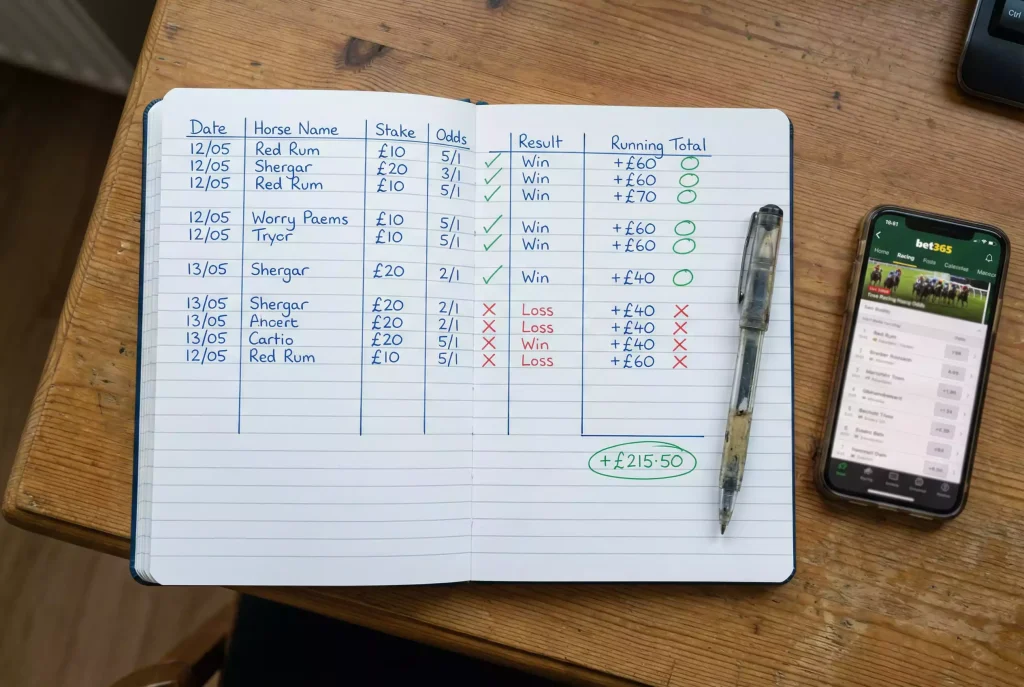
This guide covers the three most common staking methods — level stakes, percentage staking, and a simplified version of the Kelly criterion — explains when each is appropriate, and addresses the specific challenges that the all-weather season’s fixture density creates for bankroll discipline.
For racing strategies visit chelmsford betting.
Staking Methods: Which One Suits Your Approach
Level stakes. The simplest method and, for most punters, the most sensible starting point. You bet the same amount on every selection, regardless of price or confidence level. If your unit is £10, every bet is £10 — whether the horse is 2/1 or 12/1, whether you consider it a strong fancy or a speculative punt. Level stakes remove the most dangerous variable from your betting: the temptation to increase the stake on the bets you “really fancy,” which are often the bets where your emotional conviction outweighs your analytical reasoning.
The advantage of level stakes is transparency. After 100 bets at £10 each, your profit or loss is a clean number that reflects the quality of your selections, not the quality of your staking decisions. If you are profitable at level stakes, you have a genuine edge. If you are not, no staking plan will fix the underlying selection problem. Level stakes also protect against catastrophic loss. No single bet can damage the bankroll beyond one unit, and a losing run of ten bets — painful but entirely normal in horse racing — costs exactly ten units. Compare that to a punter who doubles up on their “bankers” and gets three wrong in a row: they might lose the equivalent of 20 or 30 level-stakes units in half the number of bets.
Percentage staking. A step up in sophistication. Instead of betting a fixed amount, you bet a fixed percentage of your current bankroll on each selection — typically between one and three per cent. If your bankroll is £500 and you use a two per cent method, your first bet is £10. If you win and your bankroll grows to £520, the next bet is £10.40. If you lose and the bankroll drops to £490, the next bet is £9.80. The stakes adjust automatically to reflect the current state of the bank.
Percentage staking has a mathematical advantage: it makes it almost impossible to go bust, because as losses accumulate, the stake shrinks. It also capitalises on winning runs, because the stake grows as the bankroll grows. The drawback is that recovery from a drawdown is slower than with level stakes, because each subsequent bet is smaller. For punters with a proven positive edge, percentage staking is the most robust long-term approach. For punters still testing whether they have an edge at all, level stakes is more diagnostic.
Kelly criterion (simplified). The Kelly formula calculates the optimal stake based on your estimated edge and the available odds. The full formula is: stake = (bp – q) / b, where b is the decimal odds minus 1, p is your estimated probability of winning, and q is 1 minus p. If you believe a horse has a 25 per cent chance of winning (p = 0.25) and the odds are 5.0 decimal (b = 4), the Kelly stake is (4 × 0.25 – 0.75) / 4 = 0.0625, or 6.25 per cent of your bankroll.
In practice, full Kelly is too aggressive for most punters because it relies on accurate probability estimates, which are inherently uncertain. A common refinement is to use half-Kelly or quarter-Kelly — dividing the calculated stake by two or four — which preserves the proportional logic while dramatically reducing the volatility. Kelly staking is intellectually elegant, but it requires honest and accurate self-assessment of each horse’s true probability. If you overestimate your edge — and most punters do — Kelly will over-stake and accelerate losses. It is best reserved for experienced bettors with a long track record of calibrated probability estimates.
The context for all of this is a market under pressure. The HBLB’s 2026/25 Annual Report noted that average turnover per race fell roughly eight per cent year-on-year — the third consecutive annual decline. Thinner markets mean wider bookmaker margins and less liquidity on exchanges, which makes disciplined staking more important, not less. When the market is thinning, the punters who survive are the ones whose bankroll management can absorb variance without forcing reckless recovery bets.
All-Weather Betting: Managing Volume and Frequency
The all-weather season presents a specific bankroll challenge that turf racing does not: volume. The AW Championships alone encompasses more than 200 fixtures across six venues from October to Good Friday. Chelmsford contributes two or three meetings per week during the core winter period. For a punter who bets on every Chelmsford evening card, that could mean 15 to 20 betting opportunities per week across six or seven races per meeting. At level stakes of £10 per bet, 20 bets a week is £200 in turnover — £800 a month, £4,800 over the six-month winter season.
See also: responsible gambling at the races — practical tools and support resources.
That volume demands a bankroll large enough to absorb extended losing runs without distress. The standard advice — and it is sound — is to have a betting bank of at least 50 units. At £10 per unit, that is £500. At £20, it is £1,000. The bank should be money you can afford to lose entirely without it affecting your life. If losing the bank would cause financial hardship, the bank is too large.
The second volume-related discipline is selectivity. Just because Chelmsford is racing tonight does not mean you need to bet on every race. The most profitable all-weather punters are selective: they bet on three or four races per meeting where they have a genuine edge, and they sit out the rest. Betting on all seven races because they are there is not a strategy. It is entertainment dressed as analysis, and it dilutes whatever edge you have with bets that are essentially random.
Finally, build a stop-loss mechanism into your approach. Decide before the season starts what level of drawdown triggers a pause. A common threshold is 30 per cent of the bank: if your £500 bank drops to £350, stop betting for a week. Review your recent selections. Check whether the losses are variance (the selections were sound but the results went against you) or signal (the selections were flawed and the losses reflect poor analysis). Variance requires patience. Signal requires change. The stop-loss gives you the space to distinguish between the two before the bank erodes further.
Protect your bank, grow your edge. The all-weather season is long enough to reward disciplined punters and punish undisciplined ones in roughly equal measure. The staking plan you choose matters less than the commitment to following it without deviation, meeting after meeting, from October to Good Friday and beyond.
